
You don’t have to live with the noise.
Take back your life
from tinnitus.
Let’s find your calm together.
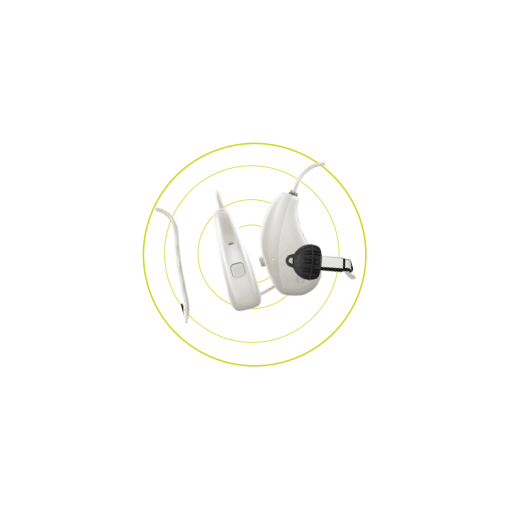


You don't have to live with the noise.
Take back
your life
from tinnitus.
Let's find your calm together.

Although there is no “magic pill” when it comes to tinnitus, there are many paths to relief.
Our Audiologists are Board Certified in Tinnitus Management and will create an individualized tinnitus relief program tailored specifically for you, based on your specific tinnitus perceptions and concerns.
Start your own process of tinnitus relief by telling us more in the solutions survey and receive personalized recommendations for your tinnitus solution options.

What is tinnitus?
We understand that you might have many more questions about your symptoms.
We’re here to talk things through.
You can start with that button below to get answers to some of the most frequent questions.
Your tinnitus relief box includes:
Self-guided cognitive therapy that really works.
Evidence-based, smartphone-enabled, and available only through select providers like us.
Includes dedicated ongoing collaborative support from our licensed audiologists.
- A daily routine that takes just ten minutes.
- A curated program tailored towards your individual challenges, goals, and needs.
- Proven track record of successful patient outcomes for just $499.
- Full sound-therapy program also available. Meet with our team today to discuss options.
Although there is no “magic pill” when it comes to tinnitus, there are many paths to relief.
Our Audiologists are Board Certified in Tinnitus Management and will create an individualized tinnitus relief program tailored specifically for you, based on your specific tinnitus perceptions and concerns.
Start your own process of tinnitus relief by telling us more in the solutions survey and receive personalized recommendations for your tinnitus solution options.
Big fix. Small box.
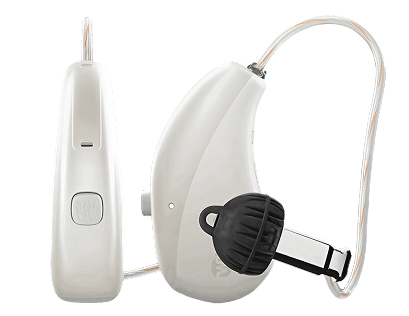
Sound therapy device
- Discrete
- Lightweight
- Comfortable
- Bluetooth streaming
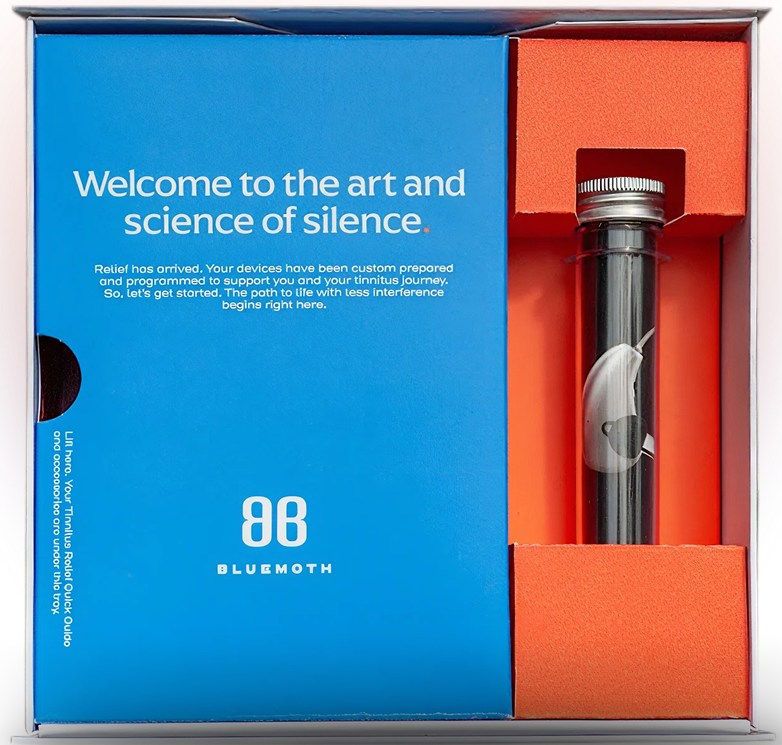
Your tinnitus relief box includes:
-
Care from real audiologists, all from the comfort of your home. No office visits. Just real relief, remotely delivered.
-
BLUEMOTH Ready-To-Help Customer Service. We’ve got your back no matter the issue.
-
12-week program Tinnitus Relief Program, built to retrain your brain.
-
Custom sound therapy technology, prescribed by your audiologist as needed.
-
Tools for our online resources for stress reduction, sleep improvement strategies and other tools for holistic tinnitus management.
-
3-year "no worries" warranty and ongoing care.
-
Telehealth support from licensed audiologists.
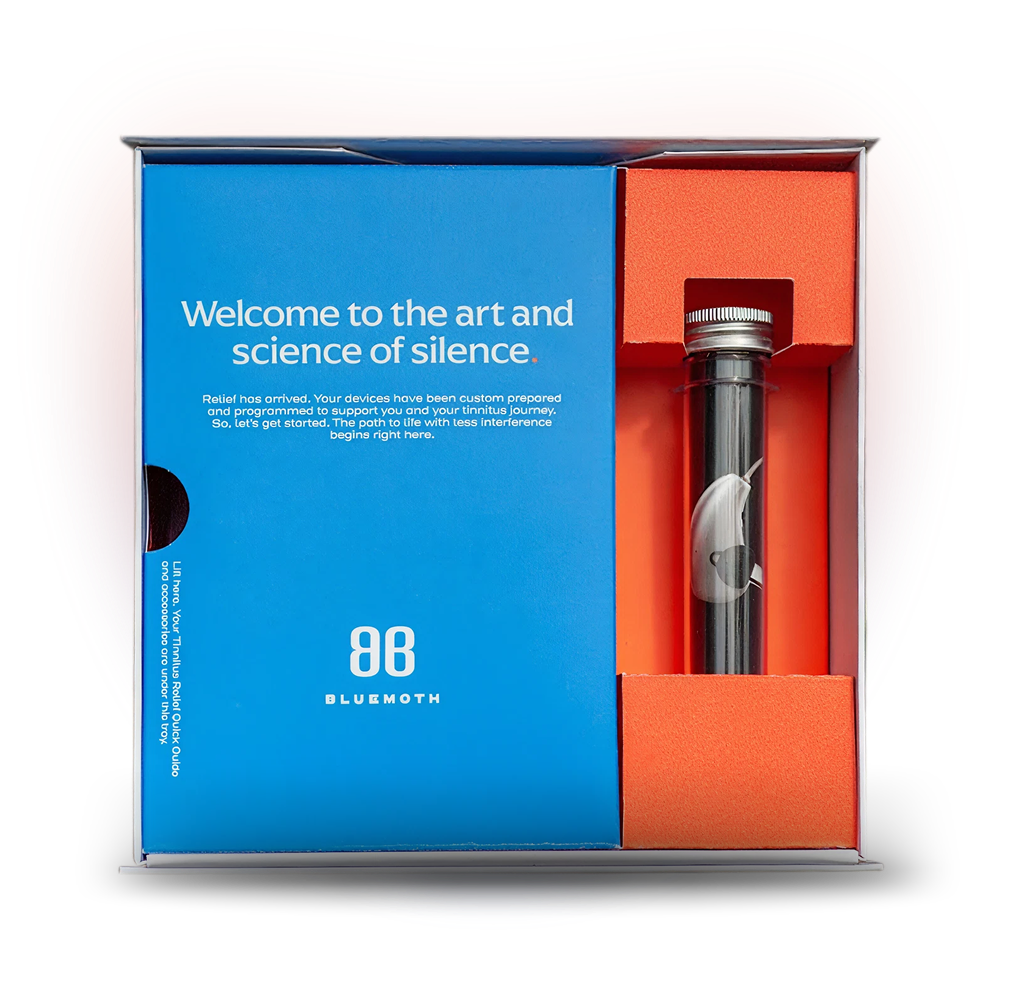
Big fix. Small box.
Sound therapy device
- Discrete
- Lightweight
- Comfortable
- Bluetooth streaming
Your tinnitus relief box includes:
-
Care from real audiologists, all from the comfort of your home.No office visits. Just real relief, remotely delivered.
-
BLUEMOTH Ready-To-Help Customer Service. We’ve got your back no matter the issue.
-
12-week retrain your brain program from Oto, built to retrain your brain.
-
Custom-matched sound therapy device prescribed by your audiologist.
-
Tools for our online resources for stress reduction, sleep improvement strategies and other tools for holistic tinnitus management.
-
3-year "no worries" warranty and ongoing care.
-
Telehealth support from licensed audiologists.
What is tinnitus?
We understand that you might have many more questions about your symptoms.
We’re here to talk things through.
You can start with that button below to get answers to some of the most frequent questions.
Your tinnitus relief box includes:
Self-guided cognitive therapy that really works.
Evidence-based, smartphone-enabled, and available only through select providers like us.
Includes dedicated ongoing collaborative support from our licensed audiologists.
- A daily routine that takes just ten minutes.
- A curated program tailored towards your individual challenges, goals, and needs.
- Proven track record of successful patient outcomes for just $549.
- Full sound-therapy program also available. Meet with our team today to discuss options.
Sound therapy device.
As low as $270 per month for the full program
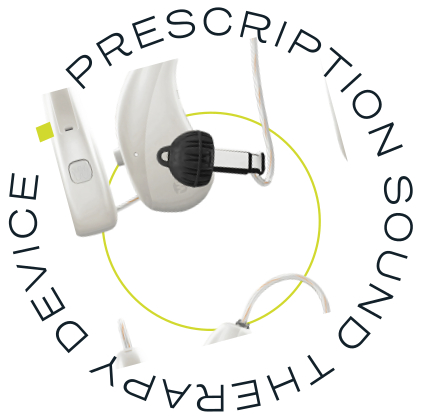
Our sound therapy devices are cutting-edge, rechargeable, and built to fit your life.
Relieve your symptoms so you can tune back into the world around you.
Sleek, phone-ready, and built for daily use.
Sound therapy device.
As low as $270 per month for the full program
Our sound therapy devices are cutting-edge, rechargeable, and built to fit your life and help you tune back in to the world around you.
Relieve your symptoms so you can tune back into the world around you.
Sleek, phone-ready, and built for daily use.
Frequently asked questions
Tinnitus
What is tinnitus?
Tinnitus is a perception of sound within a person's ears and or head. it is often described as ringing, buzzing, or hissing. It can vary in volume, pitch, and frequency.
Gimme More!
With Tinnitus, there is a perceived sound but no external sound source. This means it can only be heard by the person experiencing it. Tinnitus can be temporary or chronic and can have an array of effects on people. For some, it might only be a passing annoyance. For others, it can interfere with concentration and sleep, leading to stress, anxiety, and even depression.
With the proper treatment and support, Tinnitus doesn't have to dampen your quality of life permanently. Many people can find ways to cope effectively: including hearing technologies, therapy, and relaxation techniques. We hope to be part of your journey to a solution.
Have you heard of phantom limb pain? Essentially, Tinnitus is no different. We discussed the death of inner hair cells and how it results in Sensorineural Hearing Loss. Tinnitus, or the perception of sound when no objective sound source is present, can present for several reasons.
Down the rabbit hole.
One of the most common reasons for Tinnitus is untreated hearing loss. About 90% of people with Tinnitus have hearing loss. One of the easiest ways to explain this phenomenon, as it relates to hearing loss, is that the brain is used to receiving ear-to-brain signals when sound is registered at different frequencies. When there is high-frequency hearing loss, the brain searches for those signals, and when it does not find them because the inner hair cells have died or are damaged, the brain will create signals (AKA: phantom sounds) in their absence (AKA: Tinnitus).
What causes tinnitus?
For most, it is a symptom of underlying hearing loss. For others, it is caused by emotional and or physical trauma, noise exposure, or underlying medical conditions.
Gimme More!
There is an extensive range of causes related to Tinnitus. The most common and well-known is loud noise exposure. Aging can also be a factor. As we age naturally and our bodies (and ears!) change, the structure of the inner ear may naturally deteriorate. This can sometimes cause Tinnitus. Another possible cause is pressure from earwax blockage.
But wait, there's more! unfortunately, some medications can cause or worsen Tinnitus. This includes some chemotherapy drugs, some antibiotics, and some antidepressants. Some ear and sinus infections can even cause Tinnitus.
Is there a cure for tinnitus?
There is no "silver bullet" or "magic pill" that cures Tinnitus. MANY things can be done to reduce the negative impact on your life. As we learn more about your Tinnitus and hearing loss, we can create a customized Tinnitus management plan for you.
Gimme More!
The bad: we can't fix your Tinnitus with a one-size-fits-all solution. The good: we can work with you to create a Tinnitus management plan that fits just right.
We have many approaches to Tinnitus management to address your needs and lifestyle, including: sound therapy, counseling, medications, relaxation techniques, and the support of hearing technology.
Part of the reason there isn't one cohesive "cure" is that there are so many diverse reasons someone might experience Tinnitus. Sometimes, multiple reasons are in play at once. It also isn't yet known what the underlying mechanism that causes Tinnitus is. It's most likely a complex interaction between the auditory system, the brain, and various neural networks.
Why are hearing devices sometimes recommended for tinnitus?
Hearing loss correction should help Tinnitus perception fade into the background. Most Tinnitus is a symptom of hearing loss, so correcting that is our first priority. In cases where correction doesn't adequately treat Tinnitus alone, additional therapies, apps, and counseling will be added to your management plan.
Gimme More!
Hearing aids amplify sounds and improve overall hearing. When external sounds are enhanced, it can draw the focus away from Tinnitus. Many modern hearing aids also have special features for addressing Tinnitus. These usually generate low-level background sounds like white noise or gentle nature tones. These pleasant noises can help either wholly or partially mask your Tinnitus.
It's also believed that auditory stimulation from hearing aids promotes neuroplastic brain changes. Basically, the brain grows more used to filtering out the signal of Tinnitus and ignoring it.
Frequently asked questions
Tinnitus
What is tinnitus?
Tinnitus is a perception of sound within a person's ears and or head. it is often described as ringing, buzzing, or hissing. It can vary in volume, pitch, and frequency.
Gimme More!
With Tinnitus, there is a perceived sound but no external sound source. This means it can only be heard by the person experiencing it. Tinnitus can be temporary or chronic and can have an array of effects on people. For some, it might only be a passing annoyance. For others, it can interfere with concentration and sleep, leading to stress, anxiety, and even depression.
With the proper treatment and support, Tinnitus doesn't have to dampen your quality of life permanently. Many people can find ways to cope effectively: including hearing technologies, therapy, and relaxation techniques. We hope to be part of your journey to a solution.
Have you heard of phantom limb pain? Essentially, Tinnitus is no different. We discussed the death of inner hair cells and how it results in Sensorineural Hearing Loss. Tinnitus, or the perception of sound when no objective sound source is present, can present for several reasons.
Down the rabbit hole.
One of the most common reasons for Tinnitus is untreated hearing loss. About 90% of people with Tinnitus have hearing loss. One of the easiest ways to explain this phenomenon, as it relates to hearing loss, is that the brain is used to receiving ear-to-brain signals when sound is registered at different frequencies. When there is high-frequency hearing loss, the brain searches for those signals, and when it does not find them because the inner hair cells have died or are damaged, the brain will create signals (AKA: phantom sounds) in their absence (AKA: Tinnitus).
What causes tinnitus?
For most, it is a symptom of underlying hearing loss. For others, it is caused by emotional and or physical trauma, noise exposure, or underlying medical conditions.
Gimme More!
There is an extensive range of causes related to Tinnitus. The most common and well-known is loud noise exposure. Aging can also be a factor. As we age naturally and our bodies (and ears!) change, the structure of the inner ear may naturally deteriorate. This can sometimes cause Tinnitus. Another possible cause is pressure from earwax blockage.
But wait, there's more! unfortunately, some medications can cause or worsen Tinnitus. This includes some chemotherapy drugs, some antibiotics, and some antidepressants. Some ear and sinus infections can even cause Tinnitus.
Is there a cure for tinnitus?
There is no "silver bullet" or "magic pill" that cures Tinnitus. MANY things can be done to reduce the negative impact on your life. As we learn more about your Tinnitus and hearing loss, we can create a customized Tinnitus management plan for you.
Gimme More!
The bad: we can't fix your Tinnitus with a one-size-fits-all solution. The good: we can work with you to create a Tinnitus management plan that fits just right.
We have many approaches to Tinnitus management to address your needs and lifestyle, including: sound therapy, counseling, medications, relaxation techniques, and the support of hearing technology.
Part of the reason there isn't one cohesive "cure" is that there are so many diverse reasons someone might experience Tinnitus. Sometimes, multiple reasons are in play at once. It also isn't yet known what the underlying mechanism that causes Tinnitus is. It's most likely a complex interaction between the auditory system, the brain, and various neural networks.
Why are hearing devices recommended for tinnitus?
Hearing loss correction should help Tinnitus perception fade into the background. Most Tinnitus is a symptom of hearing loss, so correcting that is our first priority. In cases where correction doesn't adequately treat Tinnitus alone, additional therapies, apps, and counseling will be added to your management plan.
Gimme More!
Hearing aids amplify sounds and improve overall hearing. When external sounds are enhanced, it can draw the focus away from Tinnitus. Many modern hearing aids also have special features for addressing Tinnitus. These usually generate low-level background sounds like white noise or gentle nature tones. These pleasant noises can help either wholly or partially mask your Tinnitus.
It's also believed that auditory stimulation from hearing aids promotes neuroplastic brain changes. Basically, the brain grows more used to filtering out the signal of Tinnitus and ignoring it.

Copyright © 2025 BLUEMOTH. All rights reserved.